
Don't use white gas? No worries. For canister gas, check out my post How Much Canister Gas Do I Need?
The white gas stove I've used the most is my MSR Whisperlite. I'll be using my experience with my Whisperlite to generate the numbers that follow.
 |
| My MSR Whisperlite |
Over time, I've noticed that I use something on the order of 1.5 fl oz (44ml) of white gas on a solo trip per day. For two people, I find my usage is something on the order of 2.25 fl oz (67ml) per day. If I'm melting snow, I figure on roughly doubling those amounts. These amounts include fuel used for priming. These amounts are the amounts I expect to use. Particularly in winter, you should plan for the unexpected. I typically bring an extra day or two's worth of fuel on winter trips.
So what does that equate to in terms of fuel bottles? There are a lot of different sized fuel bottles out there. I'll list some common sizes, and you can hopefully adjust from there.
A note on fuel bottles: MSR, Sigg, Primus, Optimus, Snow Peak, and Brunton fuel bottles all have the same threads and are generally interchangeable. However, you should always test your particular stove with the particular fuel bottle you intend to use before your trip. My Primus pump fits in my MSR fuel bottle, but the opposite is not true: My MSR pump does not fit in my Primus bottle. The threads on the Primus bottle are compatible, but the threads start down too low in the neck of the bottle for my MSR pump to engage.
Most manufacturers recommend that you use only their fuel bottles with their stove. That's fine, and you can't go wrong with that, but that recommendation is more about legal liability than it is about the technical requirements of running a stove. Generally, any fuel bottle designed by a reputable stove company for use with a pump should be fine, provided that it has compatible threads.
 |
| An Optimus Nova stove in use with an MSR fuel bottle. Works just fine. |
Now, fuel bottles: I'm going to list MSR's bottle simply because that's what I have a lot of. MSR has three bottles:
10 fl oz "working" capacity, 11 fl oz total capacity (300ml, 325ml)
20 fl oz working capacity, 22 fl oz total capacity (600ml, 650ml)
30 fl oz working capacity, 33 fl oz total capacity (900ml, 975ml)
Note that there is a "working" capacity and a total capacity. Why two different capacities? Well, when you run a pressure stove, you need some air space in the bottle for it to work right. MSR always marks their bottles with a fill line. Do not fill past the fill line. The capacity up to the fill line is the working capacity. The capacity up to the physical top of the bottle is the total capacity. For running a stove, use the working capacity. For storage and transport, you can fill the bottle to the total capacity.
Examples (assuming 1.5 fl oz/47ml per day)
10 fl oz (~300ml) = 6.5 days
20 fl oz (~600ml) = 13 days
30 fl oz (~900ml) = 20 days
For almost all of the trips that I've done, a 20 fl oz/600ml bottle has been plenty.
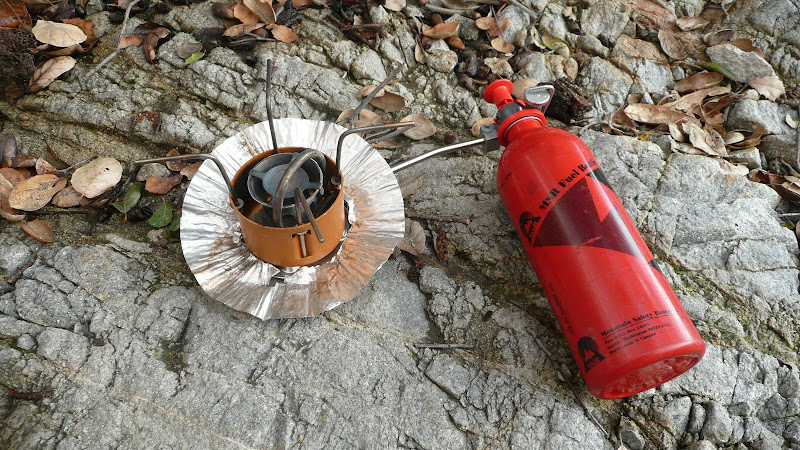 |
| A 20 fl oz/600ml MSR bottle in use with an MSR XGK II stove |
Now, these are my numbers. The only way you're going to know how much fuel you're going to use is to get out there and do some trips. These numbers are somewhat conservative by design, but you might want to carry a little extra fuel until you get it dialed in. Be aware that in windy and cold conditions, your fuel usage may go up. Hopefully these numbers will give you some rough idea of how much fuel you might want to bring along.
I thank you for joining me on another Adventure in Stoving,
HJ


Outstanding post HJ. Thank you. Blake
ReplyDeleteYou're welcome, and I'm glad it's useful to you.
DeleteHJ
Hey man,
ReplyDeleteNice article. I was especially interested about using different manufacturers' fuel bottles. I was wondering if you have any experience with the Trangia bottles? If so, you might want to anwser my question on the outdoors stackexchange website.
http://outdoors.stackexchange.com/questions/1520/are-trangia-and-msr-fuel-bottles-inter-changeable
Thanks,
Al
Al,
ReplyDeleteI believe the threads are generally compatible, BUT that's not the issue. Trangia bottles are not metal (they're a plastic like material, perhaps floridated HDPE). Trangia bottles are NOT built to handle pressure and could be very dangerous if used with a pressurized white gas stove (such as a Whisperlite, Nova, Omnifuel, etc).
On the other hand MSR bottles are aluminum. Aluminum can be corroded by alcohol. I've read reports of aluminum bottles being "eaten" by alcohol.
In short, I would not interchange the two brands.
HJ
Trangia sells a multifuel stove adapted to the trangia 25 stove set.
ReplyDeleteIt's a modified primus multifuel. It comes with a aluminum fuel bottle.
I think there is a good reason for this.
/John in Umea, Sweden.
John,
ReplyDeleteThank you for pointing out that Trangia sells a different fuel bottle, an aluminum fuel bottle, with its Trangia multifuel set up. I would definitely NOT use a regular Trangia fuel bottle for white gas on a pressure stove.
HJ
Have you done any studies on use of alcohol bottle stoves?
ReplyDeleteDouglas,
DeleteYes I have, but alcohol stoves vary widely as to their efficiency. It's a lot tougher to come up with numbers that would make sense across the wide variety of stoves out there.
The only realistic options I can see is to either a) develop your own numbers for your particular stove or b) buy a well known stove set up (an entire set up, not the stove alone) and use numbers published specifically for that stove.
HJ
Nice article! But I want to add that while your fuel usage may be conservative for someone who only uses instant meals (just add hot water), they are not very conservative for someone would use who cooks meals.
ReplyDeleteOn the PCT I used an Optimus Nova+ stove with the medium fuel bottle(450mL/15.2oz working capacity). This is a similar stove, but I think it's slightly more efficient because of the fuel-line purge feature and greater adjustability (and I usually started heating water while the stove was priming). I think a bottle lasted slightly more than a week on average (my memory is a bit fuzzy. That's not much less than the 10 days your figures calculate for this bottle, but I mostly used my stove at night, alternating between fast-cooking things like soba noodles, with slower cooked meals like pasta, quinoa, or rice, and sometiems instant foods. Granted I cook very large portions, bigger than most, and many people won't bother with 'real' cooking.. also my memory of my exact usage is a bit fuzzy..
Anyway for people who will do any kind of sustained cooking, I would suggest using a more conservative number, perhaps double the listed amount (3oz/person/day), plus a safety factor, until they are familiar with their own fuel usage patterns. 2oz is probably closer to the usage I just described.
Dan,
DeleteIt's always a good idea to use conservative estimates until a person understands their own particular fuel consumption patterns. I realize that my estimates aren't going to work for everyone; that would be impossible. I hope that people have the intelligence to realize that estimates are just that, estimates. I would hope they would take a conservative approach until they've gotten a few trips under their belt and know if they need to adjust their estimates up or down.
HJ
This comment has been removed by a blog administrator.
ReplyDeleteI fully agree with the OP, that you can generally plan most average outings on the concept of 11-oz per person per camp-week (white gas). Generally, this works well as a rough-in number, and then I add 10-percent more (20-percent in bad or heavy-winter weather). I have found, generally, that unless I am doing a lot of water purifying and the ground is really wet, or some other strange thing comes up, this works quite well overall.
ReplyDeleteTo calculate it for your trip, just figure 11-oz of fuel per person per week (2 people for 5 days would to me, be 2x11 = 22 oz, and since I'm planning for more than the 5-days, I don't need an additional buffer). Were it going to be 7-days, then I'd add 10-20 percent more (throw in that extra back-up 11-oz bottle I have, too).
This general rule has never had me overpack too bad on fuel, and never caught me short. (of course, if you are pit-fire cooking or boiling a lot, then you will end up with extra fuel). Shame MSR doesn't generalize some of this type of information for less-experienced users.
Thanks for the info. Just what I was looking for.
ReplyDeleteYou're welcome, Mike, but always test against your style of cooking. Don't go on an Arctic expedition relying solely on my numbers! :)
DeleteHJ
I know this is several months old - but I have a question: is it better to use two smaller 300 ml bottles or one larger 600 ml? I'm thinking the two bottles, might be slightly heavier than one larger, but you would technically have a little more fuel capacity for a longer trip by overfilling the bottle not in use, then transferring excess when space was available... then there are the whole physics dynamics of pressurizing a larger space in a larger bottle etc...thoughts??
ReplyDeleteIt might be simpler to just use a 750 ml or a 1000 ml fuel bottle if you have one available. Depending on what you have available, I'd weigh the bottles and see which combination (or single) of bottles is lighter. It's probably not all that significant, but remember that the average backpacker who can shave, on average, just 2 oz (~60 g) from each piece of gear would save approximately 10 lbs (~4.5 kg).
DeleteBut if your choices are restricted to two 300 ml vs. one 600 ml and you need that extra capacity, then yes, you could carry slightly more fuel because you can fill one of the 300 ml bottles completely full. You'd only need "headspace" in one of the 300 ml bottles (to avoid over-pressurization). You could refill the partially full 300 ml bottle from the full one as needed. Again, though, I think it would be lighter and simpler to just carry a 750 ml bottle if one were available.
HJ
Is there somewhere I can get information on fuel consumption using white gas for cooking - not just for adding boiling water to rehydrated meals. For example, for cooking white rice, I can easily find info on fuel needs to bring the water to a boil, but if I then turn the stove down to a low simmer for 18-20 minutes, how much fuel am I using at that point?? What about cooking dal? Same thing. I bring the water to a boil, then turn the stove down to a low simmer for 25-30 minutes. How much fuel will that consume?
ReplyDeleteI'm not aware of any. While the amount of fuel required for a fairly standard operation like a boil is fairly uniform between reasonably skilled users, simmering is not.
DeleteWhat you might do, is cook at home the meals you intend to prepare on the trail and measure the fuel consumption either by weight or by volume. Weight is typically more accurate. If you cook three times, and the fuel consumption amounts were reasonably close together, you could take the largest of the three amounts and use that for planning, which would give you some margin for error. I probably would also add 5% or 10% over the largest amount, again for a margin of error.
HJ